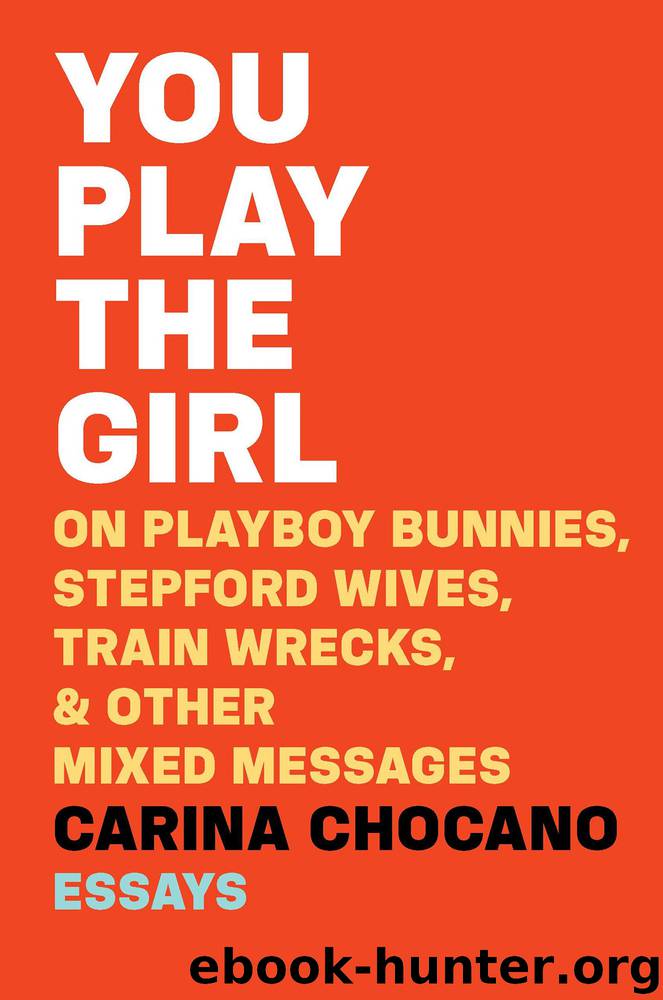
You Play the Girl by Carina Chocano
Author:Carina Chocano
Language: eng
Format: epub
Publisher: Houghton Mifflin Harcourt
I did not expect to have all these thoughts and feelings validated while watching Doll and Em, a tiny show about two Englishwomen in America, but that’s exactly what happened. Written by real-life best friends Emily Mortimer and Dolly Wells, the show is in many ways about the alienating effects of story gravity on real women—even movie stars. It is the aesthetic and ethical opposite of Gravity. Everything about the show is small: the moments, the stakes, the teeny-tiny slights and misunderstandings that trigger emotional cataclysms—which are, of course, mostly repressed. In the first season of the show, waitress and late bloomer Doll breaks up with her boyfriend in London, so movie star Em invites her to come to L.A. and be her personal assistant on a movie she is doing. It is, of course, a terrible idea; not just because Doll and Em grew up together under uncannily similar circumstances (they are almost mirror images of each other) but also because the power imbalance is too great. Em has “everything”: a husband, two kids, a home, a successful acting career; and Doll has “nothing”: no marriage, no children, no success, no home.
And yet something weird happens when Doll joins Em in L.A. on the set of a dumb movie she is making for an awful young director who treats Em, who is forty, like shit: the imbalance of power is unsustainable, and it starts to spill over into resentment, envy, passive aggression, and outright sabotage. In Doll and Em, Emily is struggling with her role as a “strong woman” whom her director describes as “the female Godfather—the strongest woman ever!” She’s supposed to cry in one scene but can’t, even though, as she tells Dolly, in real life she cries every day. She can’t relate to the part at all and feels completely alienated from it. Dolly responds by demonstrating her amazing ability to trick herself to cry on cue by thinking of something else; and Em is required to praise her. Em’s inability to connect emotionally with the idiotic role, coupled with the blatant contempt of her self-important director, erodes her confidence until it’s completely gone. The problem is that “she keeps on being told how wonderful it is that she gets to play this strong woman and how there aren’t nearly enough parts for strong women,” Mortimer said in an interview. “It’s such a cliché conversation in our business. ‘God, it’s such a wonderful opportunity to play this strong woman!’ It was just amusing to us that the more Em gets told how lucky she is, the more freaked out she feels about how she’s not nearly strong enough to play this strong woman.” This fictional strength only makes the real woman playing her feel silly and weak.
Here was a story I could relate to. I’d been so tired of “strong female characters” for so long by then. I was so tired of the way female strength was made to look cold and humorless; the way it was characterized as deviant and “unnatural” and always lonely and exceptional.
Download
This site does not store any files on its server. We only index and link to content provided by other sites. Please contact the content providers to delete copyright contents if any and email us, we'll remove relevant links or contents immediately.
| Anthropology | Archaeology |
| Philosophy | Politics & Government |
| Social Sciences | Sociology |
| Women's Studies |
The Rules Do Not Apply by Ariel Levy(4969)
On the Front Line with the Women Who Fight Back by Stacey Dooley(4872)
The Lonely City by Olivia Laing(4801)
Bluets by Maggie Nelson(4556)
The Confidence Code by Katty Kay(4260)
Three Women by Lisa Taddeo(3433)
Not a Diet Book by James Smith(3426)
Inferior by Angela Saini(3314)
Confessions of a Video Vixen by Karrine Steffans(3308)
A Woman Makes a Plan by Maye Musk(3254)
Pledged by Alexandra Robbins(3178)
Wild Words from Wild Women by Stephens Autumn(3153)
Nice Girls Don't Get the Corner Office by Lois P. Frankel(3044)
Brave by Rose McGowan(2823)
Women & Power by Mary Beard(2767)
Why I Am Not a Feminist by Jessa Crispin(2760)
The Girl in the Spider's Web: A Lisbeth Salander novel, continuing Stieg Larsson's Millennium Series by Lagercrantz David(2721)
The Clitoral Truth: The Secret World at Your Fingertips by Rebecca Chalker(2720)
I Who Have Never Known Men by Jacqueline Harpman(2669)
